Alternatives to JSON: CSV\YAML
What is JSON?
  • Human-readable and writable.
  • light weight text based data interchange format,
    simpler to read and write than XML.
  • data storage and communication format.
  • Language independent.
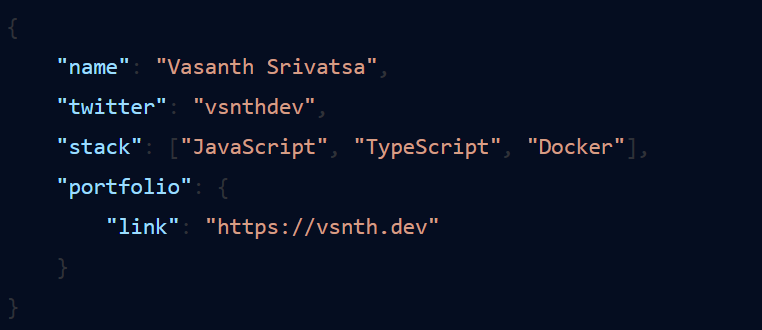
  • Code example
    What is CSV?
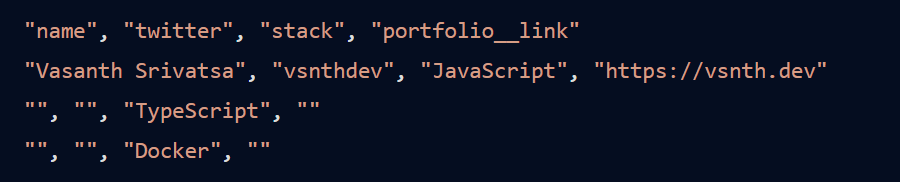
    Code example
    Info JSON CSV
    Extension Saved with the extension .json Saved with the extension .csv
    File size Large file size Compact file size
    Security Less secure More secure
    Scalability Integrates with APIs easily and allows scalability (up and down) Difficult to integrate and is not easily scalable
    Data type Uses Javascript data types (primarily) Does not use a data type.
    Hierarchy Supports hierarchical and relational data Errors when displaying hierarchical data
    Uses Stores and exchanges the syntax of data in arrays, objects, etc. Stores tabular data in a delimited text file.
    What is YAML?
    YAML JSON
    Comments are denoted with a hash/number sign. Comments are not allowed.
    Hierarchy is denoted by using double space characters. Tab characters are not allowed. Objects and Arrays are denoted in braces and brackets.
    String quotes are optional but it supports single and double quotes. Strings must be in double quotes.
    Root node can be any of the valid data types. Root node must either be an array or an object.
    Code example
    Conclusion